Blog · 2026-11-09
How a custom brick set goes from idea to bulk
A brick program is a model, a part list, a booklet, and a box. The sample has to prove all four.
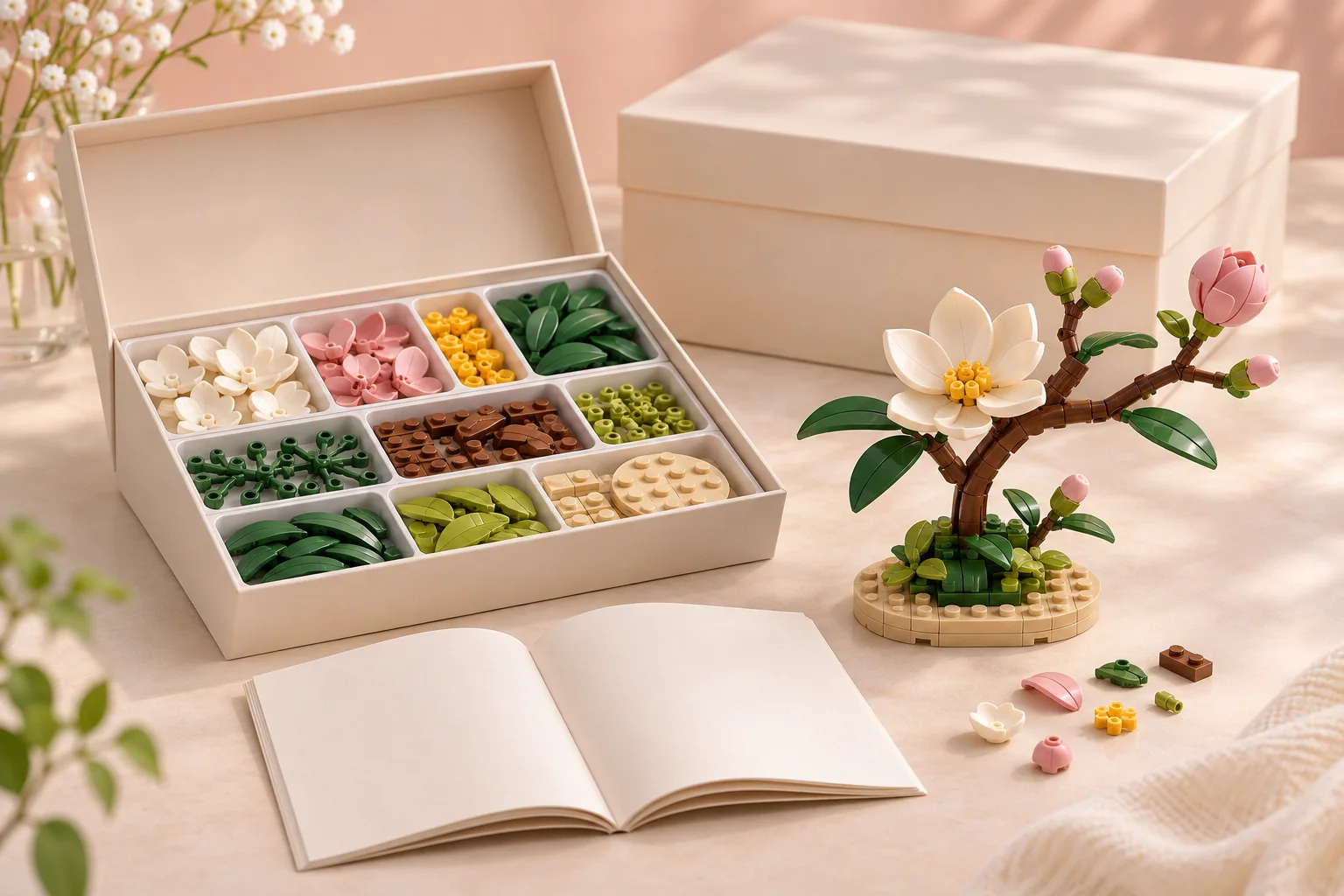
A custom brick set starts as a picture and a purpose. Some buyers arrive with a finished render and a logo. Others arrive with a product they already like and a wish to put their name on the box. The desk treats both as a brief. We ask what the set is for, who will build it, and which market it is going to. Those answers decide the part list, the booklet, and the pack before anyone talks about tooling.
Wholesale building blocks on this site are real items you can add to an inquiry. The pictures on the capabilities page are design directions, not items you can order as shown. A custom set can start from either place. Say which one it is, so we do not quote a stock build when you wanted a new model.
The model comes before the parts
The model is the thing a person will recognize on a shelf. It might be a plant, a small building, a vehicle, or a desk object. We need a view of the finished build, even a rough one, and a note about the size you have in mind. Size is a feeling at this stage, not a promise. The quotation is where the build is named in a way a workshop can make.
If the shape copies a character, a landmark treatment, or a brand you do not own, we stop. Original work, or work you already have the right to use, is the only path. A lookalike is not a shortcut we will take to make a sample cheaper.
Matching bricks to a real part list
A pretty render is not a part list. Someone has to say which elements exist, which colors are in the run, and which connections will hold when a child, or a tired adult, pulls the model apart. That matching step is where a dramatic angle gets simplified. It is better to lose a flourish on the model than to discover, after the booklet is printed, that a joint will not stay.
Color is part of the part list. A special color that is not already in the workshop's mix can change the whole job. Tell us if a color is essential to the brand, or if a close existing color is acceptable. We will not pretend they are the same thing.
The booklet and the box
The instruction booklet is a product, not an afterthought. It has to match the parts in the bag. A step that shows a piece the bag does not contain will come back as a complaint, and the complaint will be fair. We review the booklet against the packed set, not against the first sketch.
Packaging is the other half of what the shopper sees. A window box, a closed gift box, or a simple mailer changes the carton and the freight. If you already have a dieline and artwork, send them with the brief. If you do not, say so. We would rather design the pack with the set than force a set into a box that was drawn for something else. More on that sits in the note on custom packaging.
Sample, then bulk
The sample has to be buildable by someone who is not the designer. We ask you to build it, or to have a colleague build it, and to mark the step that confused you. Color, clutch, missing parts, and a booklet error are all fair reasons to hold the bulk. A verbal 'looks fine' on a photo is not approval.
Once the sample is approved, that approved set is the reference for the run. A change after approval, even a small color swap or a new logo on the box, is a new confirmation. We do not fold it into the run and hope. The quotation names what was approved. Bulk follows that, and inspection checks the packed goods against it.
Inspection is not a substitute for the build you already approved. In-line checks look for missing bags, wrong colors, and a booklet that wandered from the approved file. Pre-shipment inspection looks at the packed carton. If either one finds a drift, the goods do not get a polite pass because the schedule feels tight. Tell us, in the brief, who on your side is allowed to accept a deviation. If nobody is named, we will treat the approved sample as closed.
If you are ready to start, send the brief. Include the picture, the market, and whether you need a new model or a customization of a set we already show.